
Do you have a startup idea built on AI, but you are not sure anyone will pay for it?
I see this often in my sessions with founders. Most ideas start from a technology: "this new model can do X". Only then do we go looking for a customer.
There is a better way. Instead of the technology, start from work that a specific group already pays for. Then ask how much of that work an agent (AI software that carries out several steps of a task on its own) can deliver.
In this article we walk through that path step by step. Then we place fifteen AI-native business models on a six-rung ladder and set two more beside it. We look at three examples of each, so you can see which rung your idea sits on.
The short answer
A good idea sits where three things meet: work an agent can deliver, a budget already spent on that work, and a business model that can sell it.
- Start from an audience or an industry and the work they pay for, not from a technology.
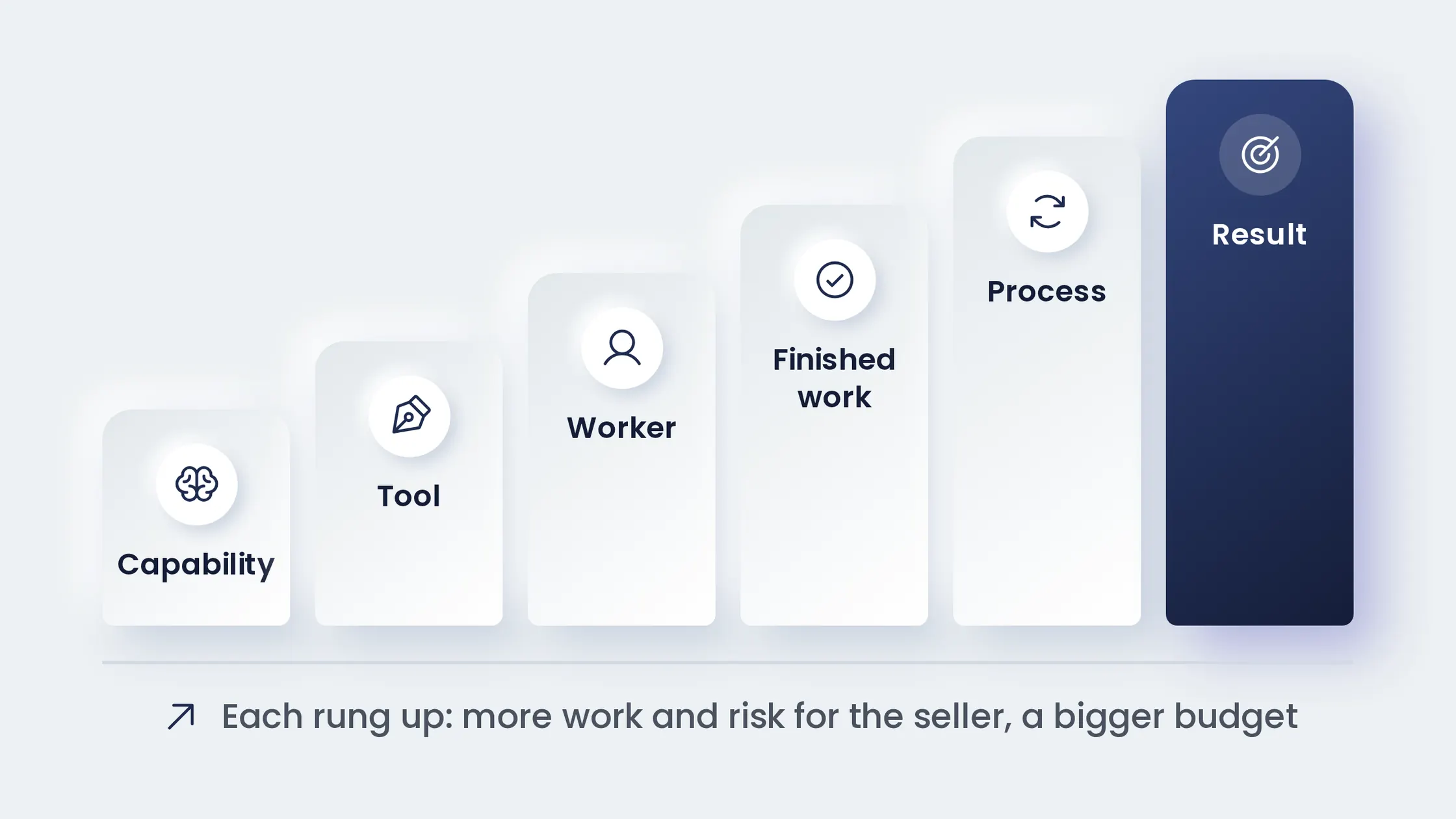
- AI-native business models sit on a six-rung ladder, from selling a capability to selling a result. One question sets each rung: who is responsible for the output?
- The higher the rung, the larger the budget within reach, and the more risk you must accept.
- An opportunity becomes truly valuable when you hold the advantage that removes its main barrier.
The path to an idea in six steps
If we should not start from the technology, where do we start?
I use this path to find startup ideas. The order matters because each step needs the answer of the one before it.
From audience to idea, step by step
- Step one
Choose an audience or an industry
Dentists, small accounting firms or freight companies, for example. The more specific it is, the easier every later step becomes.
- Step two
List all the work they pay for
Look in three places: the work of their own staff, the services they buy from outside, and the work they skip today because it costs too much.
- Step three
Ask whether an agent can deliver it
Check whether the inputs and outputs are digital, whether the work follows rules or taste, whether its output is easy to check, and how costly a mistake is.
- Step four
See how much they pay for it today
Work out what each customer spends on that work per year. Work that already has an invoice is easier to sell than work nobody pays for.
- Step five
Choose the business model on the ladder
From the fifteen models on the ladder below, choose the one the work itself allows, not the one in fashion.
- Step six
Find the advantage that makes it valuable
Every opportunity has one main barrier. The advantage that removes it turns an opportunity from interesting into valuable.
Take one point seriously: step two matters most. Services customers buy from outside today are the best targets, because they already come with an invoice and customers are used to paying for them.
Now let us see what real data says about the work AI already does, for step three.
How much of each job does AI already do?
Programmers 75% and tax preparers only 13%. Why such a gap?
Anthropic, the maker of Claude, measured how much of each job's work is done with AI in the real world. It names this number "observed coverage".
The number is not a guess. It comes from how people and companies actually use Claude, and it is computed for each task of a job.
Base: thirteen jobs from the official US classification of occupations. Each number is the share of that job's tasks where real AI use was seen. Source: the Labor market impacts data of the Anthropic Economic Index.
Does a low number mean the work is hard? Not always.
Tax returns and insurance claims are full of rules and documents. What keeps AI out is mostly liability and a signature, not the difficulty of the work.
This is a hidden opportunity. If a licensed person signs off the work, a startup can do most of it with agents and sell the same output at a fixed price.
A high number is not always an opportunity either. Where AI is already widely used, customers may simply go to ChatGPT or Claude directly and never need your product.
So "AI can do it" is not enough. The next question is which model to sell that work with.
Fifteen AI-native business models on one ladder
An AI startup can sell an API, a digital employee or the result of the work itself. What is the difference?
I place these models on a ladder of six rungs. One question sets each rung: who is responsible for the output?
Each rung up, the seller takes on more of the work and more of the risk. In return, it reaches a larger budget. The bottom of the ladder draws on the customer's software budget, the middle on salaries and services, and the top on the value of the result itself.
This ladder is about selling to businesses. Consumer models, such as a personal subscription or a free app with ads, follow other rules, so I leave them out here.
The map: fifteen models on the six rungs of the ladder
Each rung up: more work and risk for the seller, and a bigger budget
- 1CapabilityA system, not a person, uses what the customer buys. The customer is responsible for how it is used.
- CaaSCognition as a Service
- InaaSIntelligence as a Service
- DaaSData as a Service
- 2ToolThe customer's own people do the work with the software, and they are responsible for it.
- SaaSCopilot tool
- WaaSWorkflow as a Service
- 3WorkerThe customer directs an agent like a staff member, and is responsible for the result.
- AaaSAgent as a Service
- EaaSExpertise as a Service
- 4Finished workThe seller is responsible for each unit of work or each decision it delivers.
- WaaSWork as a Service
- DaaSDecision as a Service
- 5ProcessThe seller runs a whole process or a whole department, start to finish, under a set service level.
- PaaSProcess as a Service
- Full-stackFull-stack AI firm
- 6ResultThe seller carries the business risk and is paid when the result arrives.
- RaaSResult as a Service
- OaaSOutcome as a Service
- CVaaSContinuous Value as a Service
- GaaSGuarantee as a Service
- 6 to 1For every dollar spent on software, about six dollars are spent on services (Sequoia's estimate).
- 6 rungsfrom selling a capability to selling a result
- 17 modelsfifteen on the six rungs, and two outside the ladder
A small but important point: acronyms get mixed up in this field. WaaS stands for both Work as a Service and Workflow as a Service, and DaaS for both Data as a Service and Decision as a Service. That is why I always write the full name beside the acronym.
Now to each model in turn, from the bottom of the ladder. The number on each card is the number of the rung the model sits on.
Rungs 1 to 3: selling a capability, a tool or a worker
At the bottom of the ladder the product is easier to build, but that is exactly where your competitors are.
Rung 1: capability
Cognition as a Service (CaaS)
Sells general reasoning and understanding to other software through an API. This is the home ground of the large AI labs, and without unique data there is no room for a startup.
Examples: language model APIs such as Claude that teams call inside their products, a legal reasoning model sold only to legal software, and a scheduling problem solver for project management apps. Real example: Anthropic, which sells its Claude models through an API.
Intelligence as a Service (InaaS)
Sells a specialised score, alert or forecast that sits inside the customer's software. The customer or their system makes the final decision.
Examples: a fraud score for every transaction of an online shop, a credit risk score for microloan apps, and a forecast of each customer's chance of cancelling, for subscription apps. Real example: Credolab, which sends credit-risk scores to lenders by API.
Data as a Service (DaaS)
Sells unique data, or the work of human experts who write and grade data, to the labs that train AI models. Its value lies in data that cannot be found on the open internet.
Examples: doctors who grade a model's medical answers, a large set of conversations in a local language, and recordings of real accounting work, for training agents. Real example: Mercor, which sells AI labs the work of domain experts who write and grade model outputs.
Rung 2: tool
Copilot tool (SaaS)
Software a person works with, where AI helps them go faster. The work and the responsibility for the result stay with the customer.
Examples: a contract drafting assistant inside Word for lawyers, a design tool that makes several drafts for the designer to choose from, and a coding assistant inside the editor. Real example: Cursor, a coding assistant for developers.
Workflow as a Service (WaaS)
A platform where the customer builds automations that move tasks and data between their own tools. The customer designs each workflow and is responsible for it, so this is a tool, not finished work. The market is crowded, because many general tools do the same, so it works only for one specific industry with good access to its systems.
Examples: sending orders automatically from the shop to the warehouse and accounting, moving prospects from forms into the CRM and the sales team's calendar, and collecting customer documents from email and filing them in the right case. Real example: n8n, which charges per workflow execution.
Rung 3: worker
Agent as a Service (AaaS)
An agent with a defined role, tools and access that the customer gives work to like a staff member. It is usually priced monthly, against a person's salary.
Examples: a digital sales rep that finds prospects and sends the first email, a support agent that answers tickets and passes the hard ones to a person, and an admin assistant that keeps a manager's calendar, email and invoices in order. Real examples: Sable, which runs product demos for buyers, and Artisan, which sells an AI sales rep.
Expertise as a Service (EaaS)
Turns the judgement and method of a known expert or firm into an advisory agent. Its value lies in whose judgement it is, not only in the answer being right.
Examples: an AI tax adviser that has learned the method of a respected tax firm, an AI nutrition coach built on a well-known specialist's method, and an export adviser that offers years of a trade consultant's experience as an agent. Real example: Delphi, which turns an expert's knowledge into a "digital mind".
Real companies on rungs 1 to 3
Sells general reasoning to developers through the Claude API, priced per million tokens of input and output.
$47BAnnual recurring revenue · reported by the company
Growth signal: Raised a $65 billion Series H at a $965 billion post-money valuation on 28 May 2026, and says its run-rate revenue passed $47 billion that month (company-reported). Source: anthropic.com, 28 May 2026
Sells AI labs the work of domain experts who write, grade and evaluate model outputs, and takes a cut of what the labs pay the experts.
Growth signal: Its CEO said its annualized run rate passed $2 billion in gross billings, and it was reported on 9 July 2026 to be in talks to raise at a $20 billion valuation (company-reported, TechCrunch). Source: techcrunch.com, 9 July 2026
Sells an AI coding tool that helps software developers generate, edit and review code while the developer stays in control.
$1BAnnual recurring revenue · reported by the company
Growth signal: Closed a $2.3 billion round at a $29.3 billion post-money valuation on 13 November 2025 and said it had passed $1 billion in annualized revenue (company-reported). Source: cnbc.com, 13 November 2025
Sells a workflow automation platform that runs automations across a customer's tools and charges per workflow execution, not per task or seat.
Growth signal: Raised a $180 million Series C at a $2.5 billion valuation, reported on 9 October 2025. Source: techfundingnews.com, 9 October 2025
An AI employee that runs live demos for buyers by operating the software itself.
$45MRaised in total
Growth signal: Raised a $45M seed round from Sequoia and 8VC. Source: thenextweb.com, July 2026
Turns an expert's knowledge into a 24/7 'Digital Mind' that people can talk to for advice, in any language.
Growth signal: Raised a $16 million Series A led by Sequoia Capital, reported on 24 June 2025. Source: finsmes.com, 24 June 2025


From rung four up, you no longer sell a tool. You sell the work itself.
Rungs 4 and 5: selling finished work and whole processes
This is where the salary and outside-services budget opens up: the six dollars against one.
Rung 4: finished work
Work as a Service (WaaS)
Delivers finished work unit by unit, at a price per unit. It runs in two modes. In the first, an agent does the work and a person on the seller's side reviews it in a few minutes. In the second, no person is in the loop at all. This second mode is often called Service as Software (SaS), and it needs standard work whose output can be checked automatically.
Examples: review of each commercial contract at a fixed price, signed by a licensed lawyer, a tax return per case, and automatic monthly sales reports for online shops, with no person in the loop. Real examples: General Legal and Crosby, two AI-native law firms with a fixed price per contract and lawyer review. Closest example of the automated mode: Digits, which automates bookkeeping (with human accountants behind it).
Decision as a Service (DaaS)
Sells the decision itself, such as approve, decline or set a price, and often carries it out too. Unlike Intelligence as a Service (InaaS), here the seller makes the decision, not the customer.
Examples: automatic approval or rejection of microloan applications, live room pricing for a hotel, and assigning each order to the right courier. Real example: PriceLabs, which sets nightly prices for rentals and hotels and sends them straight to Airbnb and Booking.com, within limits the host sets.
Rung 5: process
Process as a Service (PaaS)
Runs a whole process from start to finish and passes only the exceptions to people. The price is per case that goes through the whole process, or monthly with a set service level.
Examples: the full customer identity check (KYC) for a finance app, a company's month-end close, and hiring from the job post to the first interview. Real example: Tennr, which runs a clinic's referral intake, from the incoming fax to the insurance check and the prior authorization.
Full-stack AI firm (Full-stack)
The startup is itself the service firm. It takes over a whole function, such as a company's bookkeeping or its legal work, for a monthly fee. Agents do most of the work and licensed people sign it off. Unlike Work as a Service, it holds the whole relationship with the client, not single units of work.
Examples: an accounting firm that runs a small company's whole finance function for a monthly fee, a law firm that acts as a startup's outside counsel on a retainer, and a recruiting firm that runs all of a company's hiring. Real example: Gradient, an AI-native accounting firm for US startups with one flat fee, where licensed CPAs sign the tax returns.
Real companies on rungs 4 and 5
An AI-native law firm for commercial contracts, at a flat $500 per contract.
$11.5MRaised in total
Growth signal: Raised $11.5M in its first three months, and more than 20 companies handed their contracts to it. Source: artificiallawyer.com, 26 March 2026
An AI-native law firm that reviews contracts at a fixed rate per document, with AI agents doing the work and human attorneys reviewing all of it.
Growth signal: Announced a $60 million Series B on 31 March 2026, led by Lux and Index (company blog). Source: crosby.ai, 31 March 2026
Sells an 'Autonomous General Ledger' where AI categorizes transactions and reconciles accounts, so the bookkeeping gets done without the customer doing it.
Growth signal: Said on 10 March 2025 it had raised nearly $100 million, with plans starting at $100 a month (company press release). Source: finance.yahoo.com, 10 March 2025
Sets nightly prices for short-term rentals and hotels and sends them straight to Airbnb, Booking.com and more than 160 property systems, within limits the host sets, for a monthly fee per listing.
Growth signal: Launched its Revenue Accelerator on 8 April 2026, and says it prices more than 700,000 properties every day for over 80,000 customers (company-reported). Source: newswire.com, 8 April 2026
Runs a clinic's referral intake with AI, from the incoming fax to the insurance check and the prior authorization.
Growth signal: Raised a $101 million Series C led by IVP, announced on 18 June 2025 (company press release). Source: prnewswire.com, 18 June 2025
An AI-native accounting firm for US startups: AI does the staff work for one flat fee, and licensed CPAs sign the tax returns.
$4MRaised in total
Growth signal: Came out of stealth with a $4 million pre-seed round, reported on 20 October 2026, and says it has reconciled over $40 million (company-reported). Source: techfundingnews.com, 20 October 2026


And now the top of the ladder, where you no longer sell work but results.
Rung 6: selling the result
If you are sure your work delivers, wouldn't it be better to get paid only when it has?
Rung 6: result
Result as a Service (RaaS)
The customer pays per countable result. The result must already be counted today, be tied to your work and arrive within weeks.
Examples: a fee per sales meeting booked, a share of every overdue payment collected, and a fee per insurance claim approved. Real example: Sierra, which charges per resolved support conversation and usually nothing if the issue is not resolved.
Outcome as a Service (OaaS)
The seller commits to bringing a KPI to a target within a set period. There is usually a fixed fee plus a bonus tied to hitting the target.
Examples: a commitment to cut the time to collect invoices by ten days in a quarter, a commitment to lower an online shop's return rate, and a commitment to bring support response time under one hour. Closest real example: Distyl AI, which ties only part of its project fees to the client reaching business goals.
Continuous Value as a Service (CVaaS)
Continuously optimises a live metric and takes a share of the measured uplift. Proving the uplift needs a control group that the optimisation does not touch.
Examples: ongoing optimisation of an ad budget for a share of the extra sales, dynamic pricing for a shop for a share of the extra profit, and optimising a factory's energy use for a share of the savings. Closest real example: Voltus, which keeps a share of the money it earns for customers in electricity markets (a share of earnings, not strictly of uplift).
Guarantee as a Service (GaaS)
The seller makes a decision and also pays for the loss if the decision turns out wrong. What the customer buys is the guarantee, and the price is usually a share of each transaction.
Examples: approving online payments with a guarantee against chargebacks, extracting invoice data with compensation for every error, and checking contracts with an agent, insured against a missed clause. Real example: nSure.ai, which makes the approve or decline call on each payment and guarantees approved transactions against chargebacks.
Real companies on rung 6
Sells AI customer service agents and charges for outcomes such as a resolved conversation or a saved cancellation, with usually no charge if unresolved.
$150MAnnual recurring revenue · reported by the company
Growth signal: Raised $950 million at a $15.8 billion valuation on 4 May 2026 and said it topped $150 million in ARR (company-reported, CNBC). Source: sierra.ai, 10 December 2024
Builds and runs AI systems inside large companies and ties part of its project fee to the client's business objectives being achieved.
Growth signal: Raised $175 million at a $1.8 billion valuation, announced 23 September 2025 and reported by Channel Dive on 20 October 2025. Source: prnewswire.com, 23 September 2025
Runs customers' flexible energy load in electricity markets and keeps a portion of the earnings it generates for them, with nothing to pay upfront.
Growth signal: Raised a $225 million Series D announced on 8 October 2026 (company press release). Source: voltus.co, 8 October 2026
Makes the approve or decline call on each payment for digital-goods merchants and backs approved transactions with a chargeback guarantee.
$25MRaised in total
Growth signal: Raised a $13 million Series A, reported on 2 March 2022 (Calcalist), with about $25 million raised in total. Source: calcalistech.com, 2 March 2022


Time separates the first three. The first is paid per event, the second for reaching a target in a period, and the third as an ongoing share of the uplift. The fourth sells something else: a promise to pay when it gets the decision wrong.
They share one condition. Most levers of that result must be in your hands, or you are taking risk on something you do not control.
Two models are left that sit on no rung at all.
Two models outside the ladder: buying the firm and a share of each purchase
What if, instead of selling to a service firm, you bought it?
These two models do not sell work to a customer's budget, so they sit on no rung. The first owns the business itself. The second earns from the money that passes through its agent.
Outside the ladder
AI roll-up (Roll-up)
Buys an existing service firm and rebuilds its work with agents. It keeps the firm's whole margin, not only a share of a customer's software budget. It needs capital and the skill to run a service business.
Examples: buying a small accounting office and moving its clients' bookkeeping to agents, buying an insurance broker and automating its claims, and buying a translation agency and keeping its clients. Real example: Radley, which buys a radiology practice and rebuilds its whole process with agents.
Commission on agent purchases (Take rate)
An agent buys or books something for the user, and the company takes a share of each transaction, usually from the seller. The user often pays nothing, so the model works only where purchases are frequent or large.
Examples: a shopping agent that finds and buys clothes and earns a commission from the shops, a travel agent that books flights and hotels, and an agent that orders spare parts for repair shops and earns from the suppliers. The clearest real attempt so far: Instant Checkout in ChatGPT, where merchants paid a small fee on each completed purchase. OpenAI retired it in March 2026, about six months after launch, and sent checkout back to the merchants.
So which of these seventeen belongs to your idea?
How do you choose the right model? With six questions
"Taste" does not choose the business model. The "work" does.
Ask these six questions from the top of the ladder down. Each one sits on the border between two rungs, so the first yes gives you exactly one rung.
Six questions to find your rung
| Question | If the answer is yes | Models on that rung |
|---|---|---|
| Can you carry the business risk, and get paid only when the result arrives? | Rung 6: result | Result (RaaS), Outcome (OaaS), Continuous Value (CVaaS), Guarantee (GaaS) |
| Will you run a whole process or a whole department end to end, under a set service level? | Rung 5: process | Process (PaaS), Full-stack AI firm |
| Will you be responsible for each unit of work or each decision you deliver? | Rung 4: finished work | Work (WaaS), with or without human review, and Decision (DaaS) |
| Will the customer direct an agent like a staff member and be responsible for the result? | Rung 3: worker | Agent (AaaS), Expertise (EaaS) |
| Will the customer's own people do the work with your software? | Rung 2: tool | Tool (SaaS), Workflow (WaaS) |
| Does a system, not a person, use what you sell? | Rung 1: capability | Intelligence (InaaS), Data (DaaS), and Cognition (CaaS) only with unique data |
General rule: the first yes from the top is the highest rung whose conditions you all meet.
The rung says who is responsible for the output. The pricing unit is the second axis, and it can move a model up the ladder.
Sierra is a good example. What it delivers is a support agent, which sounds like rung 3. But it charges per resolved conversation, so the risk of an unresolved one is Sierra's, and that puts it on rung 6.
The usual pricing unit on each rung
| Rung | Usual pricing unit | Real example |
|---|---|---|
| Rung 1: capability | Per call, per million tokens or per record | Anthropic, per million tokens |
| Rung 2: tool | Per seat per month, or per run | n8n, per workflow execution |
| Rung 3: worker | Per agent per month, priced against a salary | Artisan, an AI sales rep in place of a hire |
| Rung 4: finished work | Per unit of work or per decision | General Legal, $500 per contract |
| Rung 5: process | Per case through the whole process, or a monthly fee with a service level | Gradient, one flat fee for all accounting and tax work |
| Rung 6: result | Per result, a bonus on a target, or a share of the uplift or of each guaranteed transaction | Sierra, per resolved conversation |
You do not have to start on the highest rung. Many startups begin with Work as a Service (WaaS), with a person reviewing each unit of work.
Once the agent becomes accurate and people correct only a few percent of outputs, they move to its automated mode, Service as Software (SaS). Once they have collected a few months of provable results, they can sell the result.
But a good opportunity still lacks one thing: a reason why you should be the one to win.
Which advantage creates a valuable opportunity?
An opportunity can be open to everyone, but it is usually valuable only for whoever holds its key.
Every opportunity has one main barrier that stops newcomers. Instead of asking "what is our advantage?", I ask "what is this opportunity's main barrier, and what advantage do you have that removes it?".
That way you can see which opportunities become valuable for you if you hold a given advantage.
Each opportunity's main barrier and the advantage that removes it
| If the main barrier is | This advantage makes it valuable | Who usually holds it |
|---|---|---|
| Reaching customers is expensive because they are scattered | A route to customers that ads cannot buy | A trade association, an online community, or someone with a customer list |
| The agent is inaccurate on exceptions | Historical data or hands-on experience | Someone who has done this work for years, or a data owner |
| The work happens inside a closed software system | Access to, or a partnership with, that software | The industry's software company, or its partner |
| The work needs a licence or a signature | A licence, or a partnership with someone licensed | A licensed professional, such as a lawyer or a chartered accountant |
| Mistakes are costly and someone must carry the risk | Financial strength or insurance to guarantee results | Larger companies or investors |
| The work is spread across many small service firms today | An existing service firm, or capital to buy one | The owner of an office or agency, or an investor |
If you hold none of these advantages, do not give up. Either find an open opportunity where the race is on speed of execution, or partner with someone who holds the key.
Method and limits
- Observed coverage
- I took the chart's numbers from the Labor market impacts data of the Anthropic Economic Index. Each number says what share of a job's tasks was done with AI in real use. It reflects Claude use only, so it is not the full picture of all AI.
- The six to one ratio
- Sequoia estimated this number in its article on services as the new software (March 2026). We did not count it ourselves.
- The examples
- I wrote the examples for each model to explain it. No specific company stands behind them. The companies shown with logos are real, and their numbers come from the source under each card. For three models (the automated mode of Work as a Service, Outcome and Continuous Value) I found no company that fits the definition exactly, so I show the closest one and say how it differs.
- The ladder
- Placing fifteen models on six rungs, and two beside them, is my own classification. I set each rung by one question: who is responsible for the output. In the real world some boundaries are thin, and one startup may combine two models.
- The names
- Full-stack AI firm and Guarantee as a Service are my own names for two models the field does not yet name in one way.
- Scope
- The ladder covers selling to businesses. Consumer models, such as personal subscriptions, free apps with ads and AI companions, are left out.
Glossary
- AI-native startup
- A startup designed with AI at its core from day one, not one that added AI later. For example, a law firm where agents do most of the work.
- Agent
- AI software that carries out several steps of a task one after another on its own, not one that only answers a single question. For example, it reads emails, creates an invoice and sends it.
- Observed coverage
- The share of a job's tasks that is done with AI in the real world. For example, 75% for programmers.
- Unit of work
- What the customer pays for each time. For example, one reviewed contract or one tax return.
- KPI
- Key performance indicator: the number used to measure success. For example, the number of days it takes to collect an invoice.
- Control group
- Part of the customers or data left unchanged, so the effect of a change can be compared against it. For example, ten percent of campaigns that are not optimised.
- KYC
- Know your customer: checking a customer's identity and documents before opening an account. For example, checking an ID card and a selfie in a finance app.
- Service level (SLA)
- Service level agreement: the seller's promise of how fast and how well a service is delivered, with a penalty if it is missed. For example, every case closed within two working days.
- Chargeback
- Money returned to a card holder after a dispute, which the shop loses. For example, when a buyer says they never made the purchase.
- Take rate
- The share of each transaction a company keeps for itself. For example, 5% of every order an agent places.
- SaaS
- Software sold as a subscription over the internet. For example, a project management tool with a monthly plan.