
Almost every week, a company that is not even two years old raises a record AI round. Thinking Machines Lab got $2B in its seed round. Project Prometheus got $12B.
So what are investors betting on? A product that already sells? Revenue that grows fast? Or something else?
The headlines do not answer this, because they mix old companies with new ones, and closed rounds with talks. Mistral AI and Lovable, for example, both date from 2023.
So I took 23 AI companies founded in 2025 or 2026, with the largest round of each that a news source confirms, up to 25 October 2026. A company counts only when a source states its founding year. This article shows what that money bought, and the one lesson a small team can take from it.
The short answer
Investors are mostly betting on famous researchers and the new AI models they might build, not on products. Model and research labs took almost all the money, while products sold to customers took about one dollar in twenty.
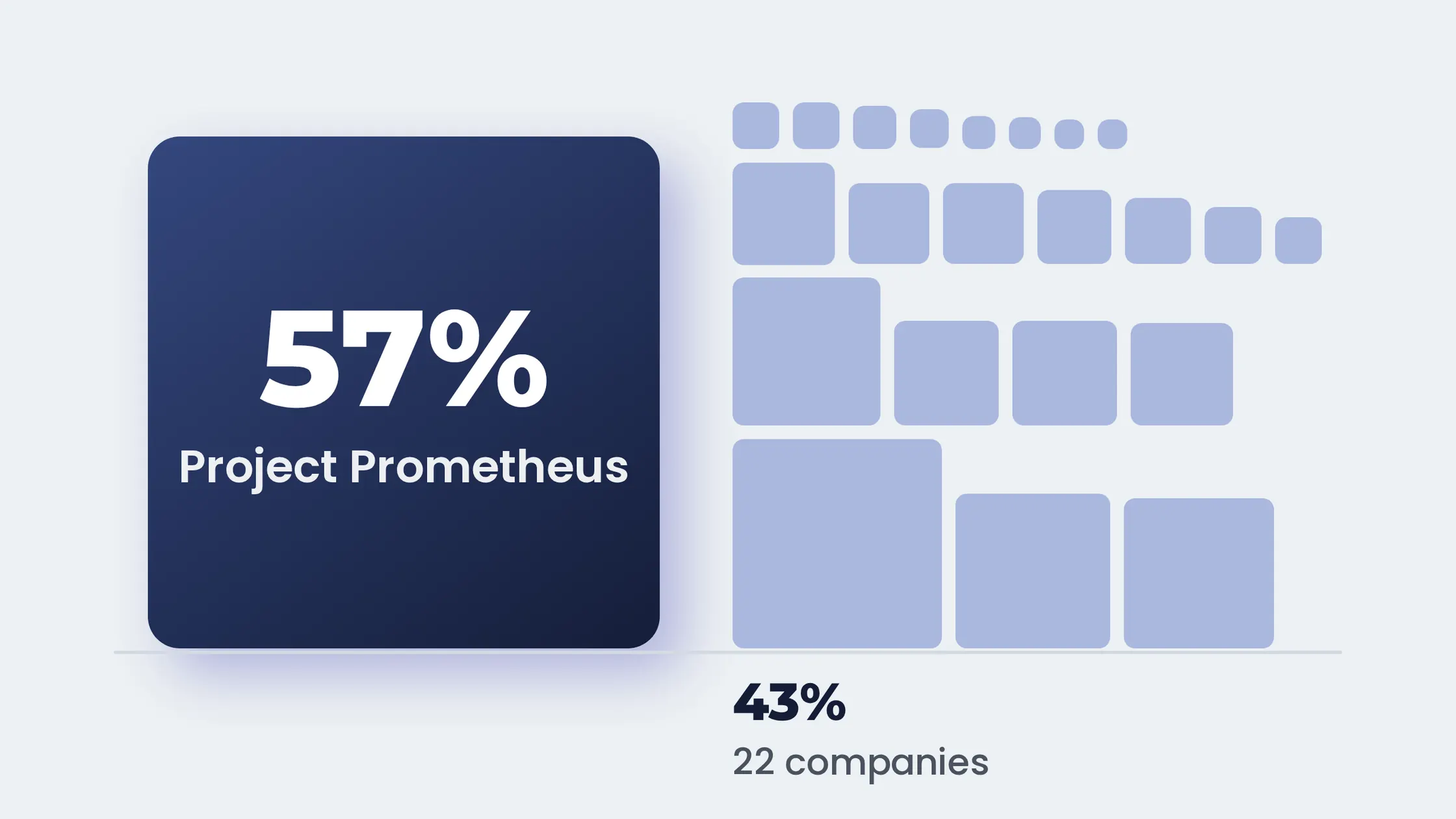
- One company, Project Prometheus, took 57% of the $20.9B with a single $12B round.
- Five rounds of $1B or more make up 82% of the total.
- Model and research labs took 89% of the money, and products sold to customers took 5%.
- For the median company, the valuation was 5.7 times the money raised in that round.
The biggest bet: one lab took more than half of the money
Of the $20.9B, $12B went to one lab that wants AI to design physical products.
Project Prometheus is a lab building AI that designs physical products for engineering and manufacturing firms. In June 2026 it raised $12B, and investors valued the company at $41B.
That one round is 57% of all the money on this list. The next four, from Thinking Machines Lab to Flapping Airplanes, each raised $1B or more.
 Thinking Machines Lab
 AMI Labs (Advanced Machine Intelligence)
 Mind Robotics
 Humans&
 Periodic Labs
 Instinct
 Upscale AI
 Inferact
 RadixArk
 Gradium
 Emergent
 Monaco
 Sable
 Wafer
 AIUC (Artificial Intelligence Underwriting Company)
Base: the largest confirmed round of each of the 23 AI companies founded in 2025 or 2026, up to 25 October 2026, from the news reports named in the method.
The five largest rounds fill almost the whole chart above, and the other 18 are only thin lines beside them. So I drew those 18 on their own in the next chart.
The median is the middle value: half the rounds are larger and half are smaller. When a few huge rounds pull the average up, the median shows a typical round better. The median of all 23 rounds is $250M. If we set the five largest aside, the median of the remaining 18 is $125M.
- Mind Robotics
- Humans&
- Periodic Labs
- Instinct
- Upscale AI
- Inferact
- RadixArk
- Gradium
- Emergent
- Monaco
- Sable
- Wafer
- AIUC (Artificial Intelligence Underwriting Company)
Base: the 18 rounds under $1B on this list, $3.79B in total, from the same news reports as the chart above.
So what exactly is all this money betting on?
The bet is on researchers and models: labs took almost nine dollars in ten
So what are investors actually buying? Mostly famous researchers and the models they might build.
A model lab is a company whose main work is research to build new AI models. A model is the engine behind a tool like ChatGPT. Thinking Machines Lab, founded by OpenAI's former chief technology officer Mira Murati, is one example.
Inference means running a model that has finished training, so that it answers a request. Every time a chatbot answers your question, that answer is one act of inference.
I sorted the 23 companies into three groups by what they build. The first is model and research labs. The second is the infrastructure AI runs on: chips, inference and networking. The third is products sold to customers.
Base: the 23 rounds on this list, $20.91B in total, grouped by us according to what each company says it builds.
Well-known researchers run these nine labs. AMI Labs was co-founded by Yann LeCun. Ineffable Intelligence is led by David Silver, formerly of DeepMind. Core Automation was founded by Jerry Tworek, a former vice president at OpenAI.
Investors here are paying for these people, and for the compute they will need. Compute is the processing power used to train and run models. Most of it comes from graphics chips, known as GPUs.
Infrastructure took $1.36B across seven companies. Inferact and RadixArk, for example, sell software that makes inference faster and cheaper.
The nine model and research labs on this list
- Project Prometheus
 Thinking Machines Lab
- Ineffable Intelligence
 AMI Labs (Advanced Machine Intelligence)
- Flapping Airplanes
- Recursive Superintelligence
 Humans&
 Periodic Labs
- Core Automation
These bets were also placed very early, in the companies' first rounds.
More than half of these bets came in a seed round, one of a company's first
Thinking Machines Lab raised $2B in its seed round.
Startups raise money in steps, and each step is called a funding round. Each round has a stage name.
A seed round is one of the first rounds a new company raises to build its product and find customers. A smaller round called pre-seed often comes before it. Sable's $45M round in July 2026, for example, was a seed round.
A Series A usually comes once the product has its first customers. A Series B comes after that, to grow faster. Mind Robotics' $500M round in March 2026 was a Series A.
Base: the 23 rounds on this list. For three of them the source does not name the stage.
Three of these seed rounds are above $1B: Thinking Machines Lab with $2B, Ineffable Intelligence with $1.10B and AMI Labs with $1.03B.
A seed round this large is not normal. This list was built from the top of the market, so it shows the exceptions, not a typical seed round.
Core Automation's $100M seed round valued the company at $1B. So it became a unicorn with its seed round. A unicorn is a startup valued at $1B or more.
If a seed round can be this large, how much do investors think these companies are worth?
The typical company on this list is valued at about six times the money it raised in that round
When Thinking Machines Lab raised $2B, investors valued the whole company at $12B.
A valuation is the price investors put on the whole company when they invest. The money they pay buys them a share of that company.
Sixteen of the 23 companies have a reported valuation. For each of them, I divided the valuation by the size of the round.
| Item | Size of the round | Valuation |
|---|---|---|
| Project Prometheus | $12B | $41B |
| Thinking Machines Lab | $2B | $12B |
| Ineffable Intelligence | $1.1B | $5.1B |
| AMI Labs (Advanced Machine Intelligence) | $1B | $4.5B |
| Flapping Airplanes | $1B | $6B |
| Recursive Superintelligence | $500M | $4.5B |
| Mind Robotics | $500M | $2B |
| Humans& | $480M | $4.5B |
| Unconventional AI | $475M | $4.5B |
| Periodic Labs | $300M | $1.3B |
| Ricursive Intelligence | $300M | $4B |
| Instinct | $250M | $2.5B |
| Inferact | $150M | $800M |
| RadixArk | $100M | $400M |
| Core Automation | $100M | $1B |
| Emergent | $70M | $300M |
Base: the 16 companies on this list with a reported valuation. Both axes use a log scale, where each step is ten times the step before.
In plain words, the typical company on this list was valued at about six times the money it raised. The highest valuation is Project Prometheus at $41B. The lowest is Emergent at $300M.
A valuation is a price, not revenue. It shows how much investors will pay today for a future they believe in.
Next to these giant bets, a few smaller ones went to products you can buy today.
Products got the smaller bets: seven companies and about one dollar in twenty
Seven of the 23 companies sell something a customer can buy today, and together they raised $1.04B.
The largest round in this group belongs to Mind Robotics: a $500M Series A. The company builds industrial robots for assembly and material handling in factories.
Instinct sells a personal AI assistant that you reach by phone or text. AIUC certifies, audits and insures AI agents.
An AI agent is software that does a task step by step on its own. For example, it can send follow-up emails to a list of buyers.
Four of the seven, with what they sell
An AI employee that runs live demos for buyers by operating the software itself.
$45MRaised in total
Growth signal: Raised a $45M seed round from Sequoia and 8VC. Source: thenextweb.com, July 2026
Modus
Invests in audit firms and rebuilds their work with AI.
$85MRaised in total
Growth signal: Raised $85M from Lightspeed. Source: pulse2.com, 9 April 2026
An AI-native sales platform where agents handle prospecting, follow-up and deal management.
$85MRaised in total
Growth signal: Raised a $50M Series B from Benchmark. Source: pulse2.com, 12 May 2026
Non-developers describe an app, and agents build and ship it.
$100MAnnual recurring revenue · reported by the company
Growth signal: Reached $100M in annual revenue eight months after launch. The company supplied this figure. Source: techcrunch.com, 17 February 2026


Modus: audit work
Modus invests in accounting firms that do audits, and rebuilds their work with AI.
An $85M seed round in April 2026.
Sable: product demos
Sable sells an AI employee that runs live product demos for buyers by using the real software itself.
A $45M seed round in July 2026.
Monaco: sales work
Monaco is a sales platform whose agents find new customers and follow up on deals.
A $50M Series B in May 2026.
Emergent: apps without code
On Emergent, people who cannot code describe an app, and agents build and publish it.
A $70M round in January 2026, at a valuation of $300M.
Modus, Sable and Monaco share one thing: they sell finished work, such as an audit or a sales follow-up. A customer can compare the price with the salary of the person who would otherwise do that work. In my view, these are the rounds a small team can learn from, not the billion-dollar ones.
Two short notes come before the lesson: where these companies are, and which famous rounds I left out on purpose.
Almost all of the money went to American companies
Eighteen of the 23 companies, and $18.11B of the money, are in the United States.
Base: the 23 companies on this list, by the country of their main office.
Europe has four companies. Ineffable Intelligence and Recursive Superintelligence are in the United Kingdom, and AMI Labs and Gradium are in France.
Only one company comes from outside the United States and Europe: Emergent, from India, with a $70M round. None of the 23 comes from Iran, Turkey or the rest of the Middle East.
And now the famous rounds I left out on purpose.
Famous rounds that are not on this list, and why
Mistral AI and Lovable raised some of the biggest AI rounds of 2025 and 2026, yet neither is here.
This list counts only companies founded in 2025 or 2026. It also counts only rounds that have closed. The table shows the best-known rounds that were left out, with the reason for each. Thrive Holdings is covered in this series' article on AI service firms.
| Company | Founded | The round in the news | Why it is not counted |
|---|---|---|---|
| Safe Superintelligence (SSI) | 2024 | A round in March 2025, and an investment from Nvidia announced in July 2026 | Founded before 2025 |
| Reflection AI | 2024 | A round in October 2025 | Founded before 2025 |
| Lovable | 2023 | A Series B in December 2025 and a Series C in August 2026 | Founded before 2025 |
| Mistral AI | 2023 | A round in September 2025, and a stake bought by Samsung in September 2026 | Founded before 2025 |
| Thrive Holdings | 2025 | More than $3B of capital, as reported | A holding company that buys existing service firms, so the money pays for acquisitions, not for building a new company |
| Thinking Machines Lab | 2025 | A new round at a valuation of $40B or more, reported in September 2026 | Still in talks: its $2B seed round is counted |
| Periodic Labs | 2025 | A new round at a valuation of about $7B, reported in March 2026 | Still in talks: its $300M seed round is counted |
| Mind Robotics | 2025 | A further $400M, reported in May 2026 | Reported only by secondary outlets: its $500M Series A is counted |
So what do all these numbers mean for a founder in Iran?
What these numbers mean for an Iranian founder
The billion-dollar rounds pay for two things: famous researchers and a huge amount of compute. An Iranian team cannot join that game, and copying it makes no sense.
The product rounds tell a different story. Modus, Sable and Monaco show what investors look for in a product. They look for finished work, a price set against a salary, and a number that grows fast.
So the practical lesson is simple. Build toward one number that proves people want what you sell, such as paying customers or monthly revenue. Do not build toward a big round. Investors follow that number, and the round comes after it.
How this list was made
- Who is included
- AI companies founded or first launched in 2025 or 2026, where a source states the year. Companies founded earlier are left out, however large their recent round.
- Which round
- For each company, the largest round that a news source confirms, up to 25 October 2026. For Gradium, the figure is its $100M seed total: a round plus its extension. Rounds still in talks are not counted.
- Valuation
- The value of the company right after the round, including the new money, as the source reports it.
- The top, not the whole market
- The search aimed at the largest rounds, so this list shows the top of the market. Its median round of $250M is not a typical startup round.
- Groups
- The three groups (labs, infrastructure, products) are my reading of what each company says it builds.
- Sources
- News reports such as TechCrunch, TheNextWeb, Pulse2 and Crunchbase News. Each figure is as reported, not checked against filings.
- Why this total differs from the map article
- Our map of 176 AI startups founded in 2025 and 2026 gives $2.06B of disclosed funding. That figure adds up what its own companies disclosed, and only 9 of them are on this list. This article instead looks for the largest rounds of any AI company founded in 2025 or 2026. So Mind Robotics appears here with its $500M Series A, and in the map with its total disclosed funding of $615M.
Glossary
- Funding round
- One step in which a startup raises money from investors. For example, Sable raised $45M in one round in July 2026.
- Seed round
- One of the first rounds a new company raises to build its product and find customers. A smaller round called pre-seed often comes before it. For example, Thinking Machines Lab's $2B round was a seed round.
- Series A and Series B
- The rounds that come after the seed round, usually once there are customers and then to grow faster. For example, Mind Robotics raised a $500M Series A.
- Valuation
- The price investors put on the whole company when they invest. For example, Project Prometheus was valued at $41B.
- Model lab
- A company whose main work is research to build new AI models. For example, AMI Labs, co-founded by Yann LeCun.
- Inference
- Running a trained model so that it answers a request. For example, each answer a chatbot gives you is one act of inference.
- Compute
- The processing power used to train and run AI models, mostly from graphics chips (GPUs). For example, a model lab rents or buys thousands of such chips.
- Unicorn
- A startup valued at $1B or more. For example, Core Automation became one with its seed round.
- Median
- The middle value of a list: half the values are larger and half are smaller. For example, the median round on this list is $250M.
- AI agent
- Software that does a task step by step on its own. For example, an agent that sends follow-up emails to a list of buyers.