
You have probably heard that AI will cut the price of a lawyer, an accountant or a recruiter to a fraction. If you own an accounting office or an agency, this either scares you or tempts you to enter the market yourself at a far lower price.
I looked up the prices of the firms already doing this work with AI. The result surprised me. Their median price is 87% of the human competitor's, and one of them charges 44% more.
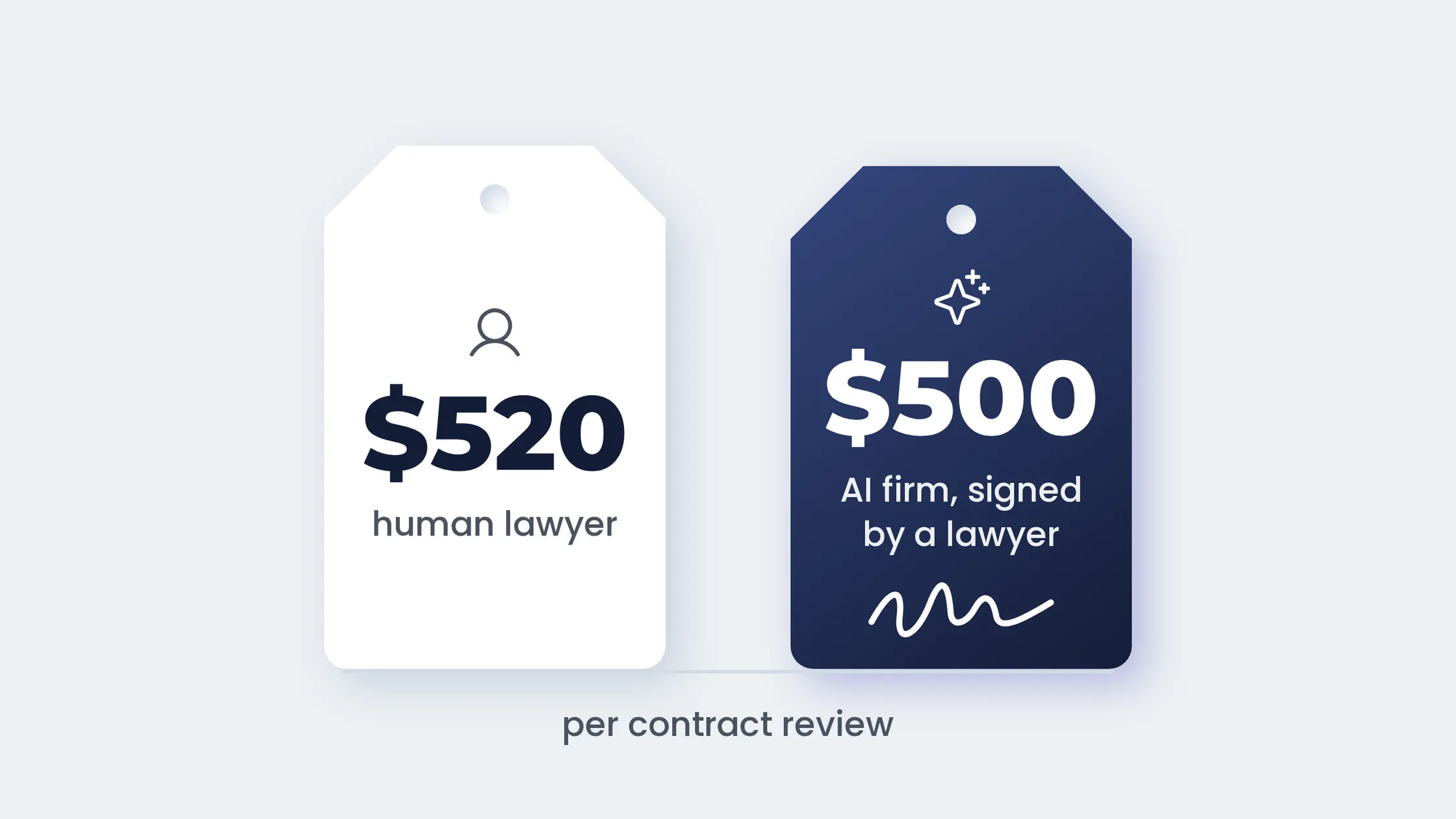
By an "AI service firm" I mean a company that sells the finished work, not software (in English this is often called service as software). For example, General Legal reviews a commercial contract for a fixed $500, and a US-licensed lawyer signs it.
In this article you will see exactly what these firms charge, what they sell if not a discount, and what this means for an Iranian service business.
The short answer: no, not much cheaper
No. The new firms that do the work of lawyers and accountants with AI do not sell a big discount. They sell a fixed price, speed and work signed by a licensed professional.
- Their median price is 87% of the human price. This figure comes from the six firms whose prices can be compared.
- Only two of them charge less than half the human price, and one charges 44% more.
- Of the 40 firms, 13 say a lawyer, an accountant or another licensed professional checks the work. The licensed person is still on the job.
- The biggest money went to a firm that buys old firms rather than competing with them on price (reportedly more than $3 billion).
AI service firms charge close to what human lawyers and accountants charge
The median price of these firms is 87% of their human competitor's price, not a small fraction of it.
Only six firms have a price that can be set against the price of the human work. For each one, we expressed the AI firm's price as a share of the human price. 100% means exactly the same price.
The median is the middle number when all the numbers are lined up from low to high. For these six firms, the median is 87%.
 Moritz
 Dex
 General Legal
 Fearn
 Falcon
Base: the six of 40 firms whose price can be compared with the human service, where 100% is the human price, from company sites and vendor and marketplace price pages.
Hiring with Jack & Jill: 40%
It charges 10% of the new hire's first-year pay. Recruiting agencies charge 20 to 30%, with a midpoint of 25%.
Contract review with Falcon: 45%
On its monthly membership, each review works out to about EUR 167. A commercial lawyer in Europe charges EUR 150 to 600 per review, with a midpoint of EUR 375.
Patent filing with Fearn: 78%
It charges $9,000 for a full patent application. A US patent attorney charges a $10,923 fee, plus a $660 fee to the patent office (2021 data).
Contract review with General Legal: 96%
It charges $500 per contract. The average flat fee for a US lawyer to review a contract is $520 (the ContractsCounsel marketplace).
Hiring with Dex: 100%
It charges 20 to 30% of the hired person's salary, the same range agencies charge. It is paid only when a hire happens.
Contracts with Moritz: 144%
Its price per commercial contract starts at $750, against the same $520. That is 44% more than the marketplace average.
One important caution: the human prices in this comparison come from vendor price pages and online marketplaces, and one of them is from 2021 data. So these figures show the order of magnitude only, not an exact percentage.
Two firms charge less than half the human price: Jack & Jill at 40% and Falcon at 45%. Two others charge 78% and 96% of the human price. One charges exactly the same, and one charges 44% more.
So what most of them sell is not a discount. It is a fixed price, speed and signed work.
If there is no big discount, why does a customer pay close to a lawyer's price to an AI firm?
The first reason: a licensed professional still signs the work
Why would a company pay an AI firm close to a lawyer's price?
Because it is not buying only the text of a contract. It is also buying a licensed person who takes responsibility for the work.
A licensed professional is someone the law allows to do that work and sign it. Examples are a lawyer, a certified accountant or an insurance broker.
Of the 40 firms, 13 write that a lawyer, an accountant, a broker or another licensed professional checks the work. Most of them do not say exactly which licence that person holds, so this is the firms' own claim. Another 8 say a person checks the work, but do not even name the profession.
The remaining 19 firms say nothing about a human check (which does not prove they have none).
Base: 40 AI service firms, where "licensed" means the firm writes that the reviewer is a lawyer, accountant, broker, radiologist or lobbyist, as the firm's own claim, from company sites, YC pages and news reports.
Law is the clearest case. Every law firm in the list that publishes a price keeps a lawyer signing the work.
At General Legal, a US-licensed lawyer is on every matter. At Fearn, an experienced patent attorney reviews every application before it is filed.
At Falcon, a qualified lawyer signs off every contract review.
The second reason is the shape of the price: instead of a discount, these firms sell a clear way of charging.
Instead of a discount, these firms charge per job, per month or a share of the result, and only 7 of the 40 publish a price figure
Of the 40 firms, only 7 publish a concrete price figure, and 24 say nothing about price at all.
A work unit is the thing the customer receives at the end and pays for. For Fearn it is one full patent application. For Dex, one person hired. So 33 firms give no figure for their price. Of those 33, 9 say how they charge but give no number. Three methods appear most often. The count for each method includes both the firms that give a figure and those that only describe the method.
A fixed price per job (3 firms)
One set price for each work unit, however long the work takes.
For example, General Legal charges $500 to review each contract.
A monthly fee (5 firms)
The customer pays a fixed amount each month and receives a set amount of work.
For example, Falcon reviews a set number of contracts each month on a monthly membership.
A share of the result (8 firms)
The firm is paid only when the result arrives, and its fee is a share of that result.
For example, Dex takes 20 to 30% of a new hire's salary, and only when someone is hired.
Base: 40 AI service firms, each counted by its main pricing method whether or not it publishes a figure, from company sites and YC pages up to October 2026.
My reading is that many of these firms sell to other companies and quote each customer separately. This is my opinion, not a figure.
So what work exactly do these firms sell at these prices?
These prices are mostly for accounting work, then legal, insurance and health work
These firms do not sell hours. They sell a "work unit", such as one reviewed contract, one month of closed books or one completed hire.
Accounting, audit and finance work is the largest group, with 11 firms. Next come 5 law firms, 4 in insurance, 4 in health, 3 in recruiting and 3 in IT and security services.
The "other services" group has 10 firms, from customer support to video production and lobbying. These are counts from our list, not shares of the whole market.
Base: 40 AI service firms founded in 2025 or 2026, from company sites, YC pages and news reports up to October 2026.
Four examples: a contract, a patent, a hire and finance work
An AI-native law firm for commercial contracts, at a flat $500 per contract.
$11.5MRaised in total
Growth signal: Raised $11.5M in its first three months, and more than 20 companies handed their contracts to it. Source: artificiallawyer.com, 26 March 2026
An AI-native patent law firm that prepares and files one full patent application for a fixed $9,000, government fees included.
Growth signal: Raised a $5.5M seed and opened in September 2026 (HackerNoon). Says it refunds the fee if no claims are allowed (company site). Source: hackernoon.com, 23 September 2026
Jack & Jill
Two AI agents for hiring: Jack coaches job seekers and Jill finds candidates for employers, who pay a fee per hire.
Growth signal: Raised a $20M seed in October 2025 (tech.eu). Its fee of 10% of first-year base pay comes from a competitor's blog (HeroHunt.ai). Source: tech.eu, 16 October 2025
AI finance staff that work through the same screens of the company's finance software.
$3.6MRaised in total
Growth signal: Has raised $3.6M. Source: ycombinator.com, 24 March 2026


Where has the investors' money gone? Mostly not to these new firms, but to buying old ones.
The most money has gone to buying old firms, not to competing with them on price
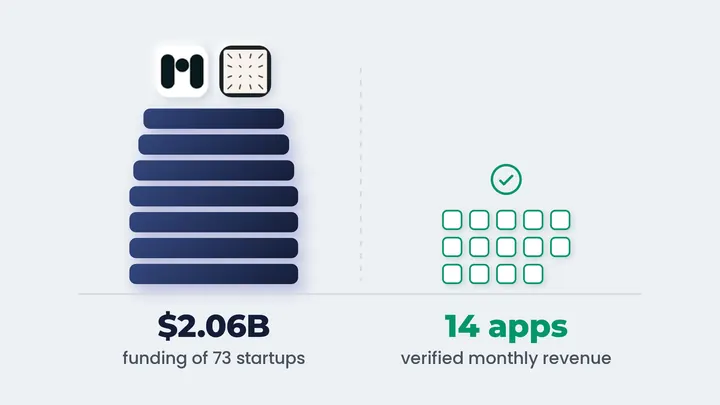
A single firm has reportedly raised more than $3 billion, more than all the other firms in this list with a funding figure put together.
These firms are called roll-ups. A roll-up is a company that buys existing businesses and rebuilds their work with AI.
For example, Radley bought an existing radiology practice to rebuild its work with AI. No funding figure has been published for Radley.
Of the 40 firms in this list, 4 are roll-ups: Thrive Holdings, Modus, Titan and Radley.
 Titan
Base: every firm on this list with a funding figure, that is the roll-ups Thrive Holdings, Modus and Titan and 9 other firms, with Thrive Holdings' figure as the reported minimum, from press reports such as TNW and Hedgeweek.
According to press reports, Thrive Holdings has bought 70+ accounting and IT-services businesses. It is valued at $12B.
Modus, with $85M raised, invests in audit firms and rebuilds their work with AI. Titan, with $74M, buys IT-services providers.
The other firms are much smaller. The other 9 firms with a funding figure raised $82.5M combined, with a median of $9M.
In my opinion, the message for the owner of an old firm is clear. Investors see the customers, experience and licences of old firms as valuable, not as something to throw away.
Has a price close to the human one held back these firms' revenue? The figures are few, but telling.
A price close to the human one has not held back revenue, though only one revenue figure is verified
A firm that charges exactly what recruiting agencies charge has reached $1.8M in annual recurring revenue (ARR) since late 2025.
- $1.8MDex's annual recurring revenue (ARR) since it began charging in late 2025, a company figure reported by Fortune
- $63.7KWhite Glove Content's monthly recurring revenue (MRR), verified from payment data by TrustMRR
- $500KLocke's annual recurring revenue (ARR) about six weeks after launch, a company figure
Monthly recurring revenue (MRR) is the money customers pay every month for a subscription. For example, the monthly subscription White Glove Content's customers pay for their video package.
Annual recurring revenue (ARR) is monthly recurring revenue times twelve. The Dex and Locke figures are annualized in this way, not revenue actually earned over a year.
Of these three figures, only White Glove Content's is verified. TrustMRR is a site that reads revenue directly from a company's payment account. The other two figures come from the firms themselves.
There is one more detail worth noting. Dex charges the same as agencies, and it has the largest revenue figure in this section. One example proves nothing, of course.
If you want to see all 40 firms yourself, the full list is below.
The full list of 40 AI service firms, searchable
Which of these 40 firms works in your profession?
All 40 firms
Filter by market, business model or country, or search for a firm by name.
An AI-native law firm for commercial contracts, at a flat $500 per contract.
Growth signal: Raised $11.5M in its first three months, and more than 20 companies handed their contracts to it. Source: artificiallawyer.com, 26 March 2026
An AI-native law firm: AI drafts, a lawyer reviews, the price is fixed.
Growth signal: Reportedly raised about $9M in seed funding. Says it has more than 50 client companies. Source: ycombinator.com, May 2026
An AI-native patent law firm that prepares and files one full patent application for a fixed $9,000, government fees included.
Growth signal: Raised a $5.5M seed and opened in September 2026 (HackerNoon). Says it refunds the fee if no claims are allowed (company site). Source: hackernoon.com, 23 September 2026
An AI-native law firm in Belgium that reviews commercial contracts on a flat monthly membership instead of billing by the hour.
Growth signal: Launched in October 2026 with a reported EUR 1.5M pre-seed (LawFuel, Non-Billable). A qualified lawyer signs off every review. Source: lawfuel.com, 3 October 2026
An AI-native law firm for financial companies, whose lawyers build AI agents for legal work. Its unit of work is one legal engagement.
Growth signal: Launched in November 2025 with more than 35 lawyers (LawNext). The $50M Blackstone investment went to its parent, Norm Ai, not to the firm. No prices are published. Source: lawnext.com, 26 November 2025
An AI-native lobbying firm that helps companies with policy work and winning government contracts.
Growth signal: Says it reached $500K in annual revenue about six weeks after starting (company figure, not verified). Source: ycombinator.com, September 2026
An accounting firm where agents do the bookkeeping and tax filings and an accountant signs off.
Growth signal: A four-person team in Helsinki. Source: ycombinator.com, September 2026
An AI-native accounting firm: an AI agent keeps the books, and in-house accountants review and close each month for a flat fee.
Growth signal: Raised a $4.5M seed led by GV and says it has more than 150 clients (The Hub profile, company figures). About 20 people in Copenhagen and London. Source: thehub.io, 2026
An AI-native accounting service that does a small business's monthly bookkeeping, reconciliation and tax reports.
Growth signal: A five-person team from YC's Spring 2025 batch. No funding, revenue or price is published. Source: ycombinator.com, 2025
Modus
Invests in audit firms and rebuilds their work with AI.
Growth signal: Raised $85M from Lightspeed. Source: pulse2.com, 9 April 2026
AI finance staff that work through the same screens of the company's finance software.
Growth signal: Has raised $3.6M. Source: ycombinator.com, 24 March 2026
Denki
Does internal audit work for compliance with US securities rules.
Growth signal: A four-person team in YC Fall 2025. Source: ycombinator.com, October 2025
Processes vendor bills, builds spend reports and suggests when to pay.
Growth signal: A four-person team that has interviewed 23 CFOs. Source: ycombinator.com, October 2025
An AI-native finance outsourcing firm that investigates cross-border transaction alerts.
Growth signal: A five-person team piloting with a $10B wealth management firm. Source: ycombinator.com, June 2026
Finance back-office outsourcing run by AI and people, with contractual quality commitments.
Growth signal: Raised a $10M seed round from Lightspeed India and Peak XV. Source: finder.techleap.nl, August 2025
AI employees for lenders: collections, underwriting, monitoring and compliance certificates.
Growth signal: A two-person team working with several credit teams. Source: ycombinator.com, June 2026
Thrive Holdings
A holding company that buys accounting and IT-services firms and rebuilds their work with AI.
Growth signal: Reported total capital of more than $3B, a $12B valuation and more than 70 businesses bought (TNW, August 2026). These are press figures, not verified. Source: thenextweb.com, 13 August 2026
An AI-native commercial insurance brokerage that automates submissions and carrier follow-up.
Growth signal: A five-person team in YC Fall 2025. Source: ycombinator.com, 2025
A licensed insurance brokerage that pairs AI with human brokers for hard-to-place risks.
Growth signal: A three-person team in live production since December 2025. Source: ycombinator.com, 2026
Automates insurance claims handling and cuts wrongful payouts.
Growth signal: Its founders previously built a neobank processing more than EUR 1B a year. Source: ycombinator.com, June 2025
Handles the back-office work of insurance claims: calls, emails, documents and data entry.
Growth signal: Landed its first customer a few weeks after its first version. Source: ycombinator.com, April 2025
An AI recruiter that finds and contacts engineers, hands interested ones to the hiring manager and is paid per hire.
Growth signal: Charges 20 to 30% of the hired candidate's salary, only on a hire. Fortune reported a $5.3M seed and about $1.8M in annual recurring revenue (ARR) in April 2026. This is the company's own number. Source: fortune.com, 28 April 2026
Finds job candidates, contacts and screens them, then delivers the ready ones in Slack.
Growth signal: A four-person team, and LlamaIndex is one of its customers. Source: ycombinator.com, January 2026
Jack & Jill
Two AI agents for hiring: Jack coaches job seekers and Jill finds candidates for employers, who pay a fee per hire.
Growth signal: Raised a $20M seed in October 2025 (tech.eu). Its fee of 10% of first-year base pay comes from a competitor's blog (HeroHunt.ai). Source: tech.eu, 16 October 2025
A holding company that buys IT-services providers and builds AI agents for IT support.
Growth signal: Raised $74M in a round led by General Catalyst in August 2025, with its first purchase, RFA, a firm of about 300 staff (Hedgeweek). Source: hedgeweek.com, 13 August 2025
Netsec
Runs IT and security for mid-sized companies in one place, with AI-native operations.
Growth signal: Raised more than $10M from Partech. Source: pulse2.com, 11 October 2026
An AI-native medical billing company, starting with ambulance claims: AI calls insurers and a small team of billers backs it.
Growth signal: A one-person team from YC's Winter 2026 batch, per its YC page. Says it charges a fraction of the usual cost, but publishes no price. Source: ycombinator.com, 2026
Buys a radiology practice and rebuilds it with AI agents.
Growth signal: Annual revenue, including the acquired practice, is $4.6M. Source: ycombinator.com, September 2026
Audits employers' medical bills and finds overpayments.
Growth signal: The founders' earlier tool helped 60 patients cut more than $300K from their bills. Source: ycombinator.com, 2025
Hera
Combines AI tools with human caregivers so families can coordinate care for an aging relative.
Growth signal: Raised a $27M Series A. More than 1,000 families are customers, with 95% retention. Source: inforcapital.com, 29 June 2026
Automates customer support for travel companies across phone, email and chat.
Growth signal: Its founders previously built Flightfox, with $20M in revenue. Source: ycombinator.com, June 2025
An AI-native debt collection firm that negotiates and sets up payment plans by voice, text and WhatsApp.
Growth signal: A five-person team in Oslo. Source: ycombinator.com, September 2026
Wins back lost customers by text, email, WhatsApp and phone.
Growth signal: A three-person team in Mexico City that was in YC Fall 2025. Source: ycombinator.com, October 2025
Makes about 25 AI video ads a week and runs the Meta campaign.
Growth signal: A six-person team selling a full done-for-you service on a monthly subscription. Source: ycombinator.com, June 2025
A subscription service for faceless videos: script, AI voice, editing and thumbnail.
Growth signal: Verified monthly revenue of $63,673, six months after starting. Source: trustmrr.com, 25 October 2026
A short-term rental management company that uses AI to charge half the usual fee.
Growth signal: A two-person team managing 80 properties. Source: ycombinator.com, 2026
An AI-native real estate firm that handles sales and property management at lower cost.
Growth signal: A three-person team in YC Summer 2025. No revenue figure disclosed yet. Source: ycombinator.com, 2025
Automates engineering design, starting with site assessment for data centers.
Growth signal: Had $70K in revenue and $4M in contracts in its first month. Source: ycombinator.com, September 2026
Agents that keep running test attacks on apps and infrastructure to find the holes.
Growth signal: Reportedly reached $1M in annual revenue in eight weeks. Source: arr.club, 1 May 2026
Handles parts sourcing, quotes, payment, shipping and customs for hardware teams.
Growth signal: A three-person team in Bengaluru. Source: ycombinator.com, August 2026


No company matches these filters.
If AI does not break the price, what should an Iranian service business compete on?
If you run an accounting office, a law practice or an agency, my conclusion from this data is simple. A low price is not your winning card.
The firms doing this work today set a fixed, published price for each job and deliver fast. The customer knows from the start what they will pay and when they will receive the work.
Keep your licensed professional and make that person the main promise of your service. The customer pays for that person's signature, not only for the text.
An existing office is closer to this model than a software startup is. You already have the customers, the experience and the licence. The main job is to rebuild your work with AI and sell the same result faster, at a fixed price.
A local licence and the Persian language are things a foreign firm cannot copy. For example, a US firm cannot deliver a Persian contract signed by an Iranian lawyer licensed by the bar.
How this study was done
- Which firms
- 40 firms that sell finished work, such as a reviewed contract, closed books, a handled claim or a hire. All were founded or first launched in 2025 or 2026. Sources are company sites, news reports and the firms' pages at YC, an American accelerator that gives new startups money and advice.
- Link to the list of 176
- Our list of 176 new startups has 45 companies that sell finished work. 30 of them are here, and 10 firms are new to this study. The rest of the 45 sell data, engineering or home-service software and are not in this article.
- Human prices
- These prices come from vendor price pages and online marketplaces, such as ContractsCounsel and HeroHunt.ai. One is from 2021 data. So they show the order of magnitude only.
- Human check
- We counted a firm as "licensed" when it names the profession of the reviewer: lawyer, accountant, broker, radiologist or lobbyist. Most do not state the licence itself outright.
- Company figures
- Most funding and revenue figures come from the firms themselves or from news reports, and we say so wherever that is the case. Only a figure TrustMRR verified from payment data counts as verified.
- Counts, not market shares
- These 40 firms are a selected list, not the whole market. So the counts show patterns, not market shares.
- Date
- The data was collected up to October 2026.
Glossary
- AI service firm (service as software)
- A company that does the finished work with AI and sells it, instead of selling software. For example, General Legal sells contract review, not a contract review tool.
- Work unit
- The thing the customer receives at the end and pays for. For example, one reviewed contract or one completed hire.
- Fixed price per job
- One set price for each work unit, however long it takes. For example, $500 to review one contract.
- Monthly fee
- A fixed amount the customer pays each month for a set amount of work. For example, a monthly membership to review several contracts.
- Share of the result (pay per result)
- The firm is paid only when the result arrives, and its fee is a share of that result. For example, a share of a new hire's salary.
- Roll-up
- A company that buys existing businesses and rebuilds their work. For example, Radley, which bought a radiology practice.
- Licensed professional
- Someone the law allows to do a professional job and sign it. For example, a lawyer, a certified accountant or an insurance broker.
- Median
- The middle number when all the numbers are lined up from low to high. For example, the median of five numbers is the third one.
- ARR (annual recurring revenue)
- Monthly recurring revenue times twelve. For example, a thousand dollars a month means twelve thousand dollars a year.
- MRR (monthly recurring revenue)
- The money customers pay every month for a subscription. For example, a hundred customers paying ten dollars a month make a thousand dollars of MRR.
- TrustMRR
- A site that reads startups' monthly revenue directly from their payment provider, such as Stripe. So its number is not the founder's own claim.
- YC (Y Combinator)
- An American programme that gives new startups money and advice in return for a small stake. It runs four batches a year, and the companies in each batch start together.