
Picture an American AI tool. It assumes the customer has an international card, speaks English, and can send data to a server in another country. For an Iranian founder, all three assumptions are wrong.
Those three wrong assumptions are where some new startups in India, Turkey, Saudi Arabia, Egypt and Latin America build. These countries are called emerging markets: their economies are growing, but they lack the money and infrastructure of the United States.
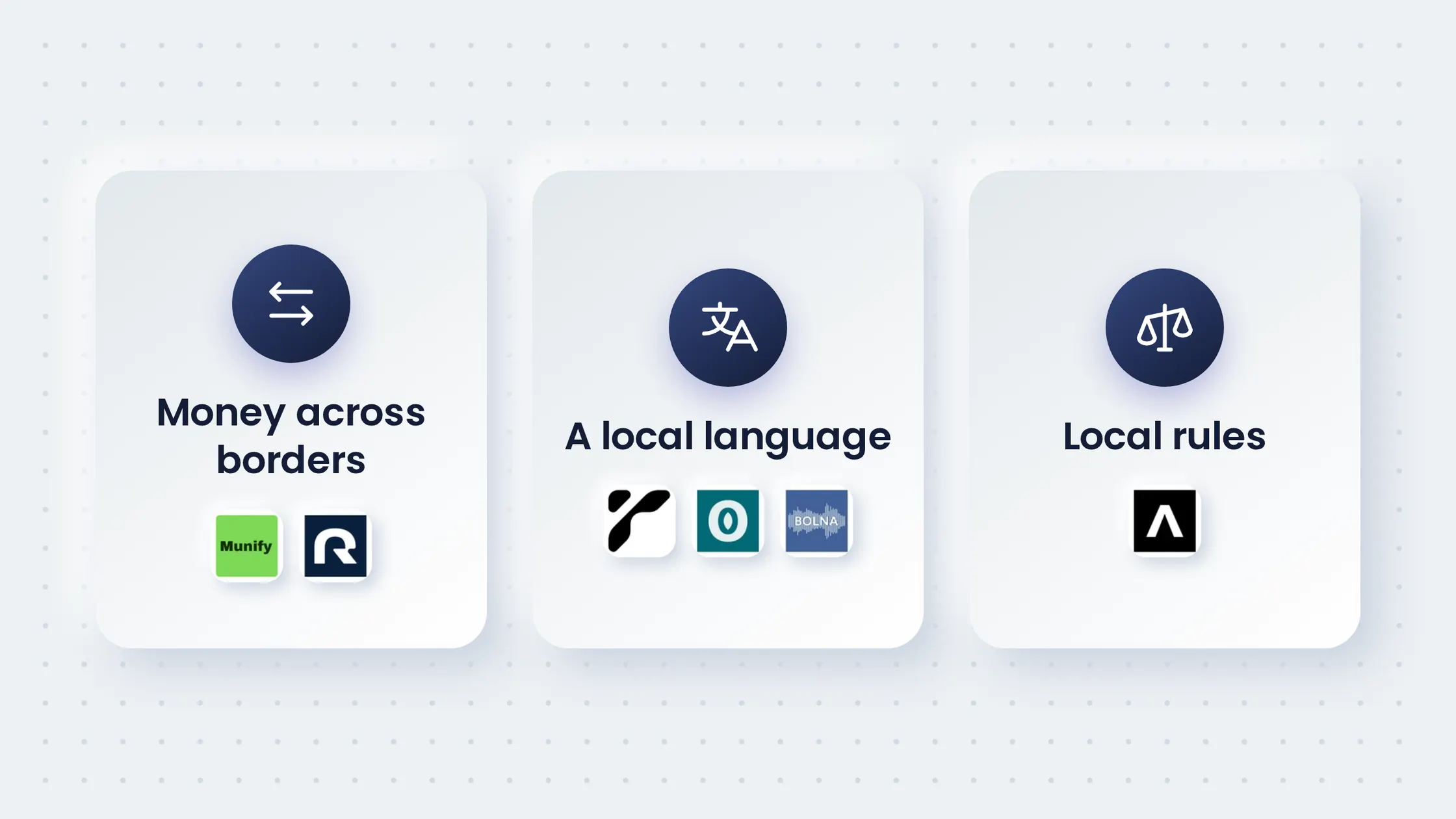
Of 35 AI startups that started in these markets since 2025, 14 work on at least one of the three problems: moving money across borders, a local language, and local rules.
In this article I show each problem with the companies building on it. Then you will see where these companies are and how much money they work with. At the end, I say what an Iranian team, which knows all three problems up close, can take from them.
The short answer
American AI tools assume three things: an international card, the English language, and permission to send data abroad. 14 of these 35 startups build exactly on those three gaps. The rest do other things.
- A local language comes up most often, in six companies, such as Bolna in India and Freya in Turkey.
- Local rules come up in five companies, such as Safahat.ai in Istanbul, whose software installs on the customer's own servers.
- Moving money across borders comes up in four companies, such as Munify in Egypt and Ruvo in Brazil.
- These companies work with less money: their median latest round (a round is one batch of money raised from investors) is $2.5M, against $9.6M for the rest of our list of 176.
Three problems US AI tools ignore, and 14 of the 35 companies build on them
Why does an American AI tool, with all its money and staff, fall short in these markets?
The answer lies in those three assumptions. American tools are built for American or European customers, and in emerging markets each of these assumptions can be wrong.
I sorted the 35 companies by their product descriptions. 14 of them build on at least one of these three problems. The rest do other things: several Indian companies, for example, build tools for developers.
Base: the 35 companies in this list. The sorting is ours, based on each company's product description, and Vrtx counts in two groups.
The first problem is moving money across borders. A cross-border payment is money that goes from one country to another, such as the fee an Egyptian freelancer receives from an American client.
In many of these markets, that is expensive, slow or simply blocked. Munify in Egypt sends remittances for Egyptians abroad and gives Egyptian freelancers a US bank account.
SaturnX in the UAE lets businesses move money almost instantly with stablecoins. A stablecoin is a digital currency whose value is tied to the dollar, so one unit is worth about one dollar.
Companies that build on moving money across borders
 Munify
- SaturnX
- Vrtx
 Ruvo
The second problem is language. Large AI models learned mostly from English text, and they usually understand Arabic, Turkish or Indian languages less well, especially in local dialects.
Popcorn Studio AI makes video with AI, from script to voiceover, with a focus on Arabic dialects. Bolna in India lets companies build multilingual phone agents.
An AI agent is software that does a task from start to finish on its own, for example answering a customer's call and booking an appointment.
Companies that build on a local language
- Popcorn Studio AI
 Bolna
 Freya
 Aligator
- Nanovate
- Mello (Companion Labs)
The third problem is local rules. Many banks, courts and government bodies are not allowed to send their data to a server in another country.
This rule is called data residency. For example, a bank's customer files must stay on a server inside the same country.
Safahat.ai in Istanbul sells AI legal software, with a version that installs on the institution's own servers. Vrtx in Saudi Arabia builds wallets and cards for businesses and holds in-principle approval for an e-money licence from Saudi Arabia's central bank.
Companies that build on local rules and data residency
- Safahat.ai
- Vrtx
- Think
- Echelon
 Armeta AI
These problems are not tied to one country. The next section shows where the companies come from.
In this list, most companies come from India (13) and Turkey (7)
The companies building on these three problems are spread from India to Egypt and Brazil.
I only put a company in the list if it was founded or launched its product in 2025 or 2026 and has its main office in an emerging market. Each company also needs a sourced growth signal, such as a funding round, revenue, or a place in an accelerator.
An accelerator is a program that gives new teams money and advice in return for a small stake. The best known is Y Combinator, or YC, in the United States, which takes four batches of teams a year.
With this rule I reached 35 companies. India has the most with 13 and Turkey follows with 7, then come Saudi Arabia, the UAE and Egypt.
Base: 35 AI startups founded in 2025 or 2026, from regional press, YC pages and accelerator pages, up to October 2026.
Nigeria, Kenya, South Africa, Indonesia, Vietnam, Pakistan, Jordan, Uzbekistan, Armenia, Georgia and Azerbaijan are missing from this chart. Our search found no sourced company founded in 2025 or 2026 there. This is a limit of our search, not proof that those markets have no AI startups.
How much money do these companies work with? The next section shows the numbers.
These startups raise smaller rounds: a median latest round of $2.5M against $9.6M for the rest of the list
19 of these 35 companies disclosed the size of their round, and the middle value is only $2.5M.
The median is the middle value when all the rounds are lined up from smallest to largest. It matters here because Emergent's $70M round pulls the average up but does not move the median.
You will also see two round names often. Seed funding is one of the first rounds of money a new company raises from investors to build its product and find customers. Loops AI in Turkey, for example, raised a $3.5M seed round. A smaller round called pre-seed often comes before it. Safahat.ai, for example, raised $590K in pre-seed.
On both sides of this comparison I counted each company's latest disclosed round. The median is $2.5M for the 19 companies in this article and $9.6M for the 66 non-emerging companies in our list of 176, the list in this series' main article on new AI startups worldwide.
Base: the latest disclosed round of 19 companies in this article, against the latest disclosed round of 66 non-emerging companies in our list of 176, from each round's announcement.
 Emergent
 Neoflo.ai
 Bolna
 Kily
 Munify
 KLIQ
 Ideasets
 Mindra
 Aligator
 Armeta AI
Base: the last disclosed round of 19 of the 35 companies, from each round's announcement. Emergent has offices in Bengaluru and San Francisco and is counted as Indian here.
- 19 of 35companies disclosed the size of their round.
- 15 of 35companies have neither a disclosed round nor revenue.
- 2 of 35companies report a revenue number.
The two revenue numbers in this list are not the same kind. Emergent says its annual recurring revenue (ARR) reached $100M, but that figure comes from the company itself. Boothie makes $51.8K a month, and that figure is read from its payment system.
Now to the country closest to us: Turkey.
Seven Turkish startups: Freya builds on language, Safahat.ai on local rules, and Boothie has verified revenue
In Turkey, the country closest to us, two of the three problems show up directly: language and local rules.
Freya got into YC from Istanbul and builds voice agents for Turkish banks and insurers, which means it builds on a local language. Safahat.ai raised $590K in pre-seed from a fund of the Albaraka Türk group and has a version that installs on the institution's own servers, which means it builds on local rules.
The other Turkish companies do not build on these three problems, but each has a growth signal. Boothie re-renders a selfie in the style of an old digital camera, Kodak film or a photo booth. It is the only Turkish company in this list with verified revenue: $51.8K a month.
Monthly recurring revenue (MRR) is the money customers pay every month for a subscription. Boothie's figure is verified by TrustMRR, a site that reads startups' monthly revenue directly from their payment provider, so the figure is not the founder's own claim.
Loops AI raised $3.5M, and large Turkish retailers such as Mavi and Boyner are its customers. Mindra, with $1.2M in pre-seed, builds a tool that coordinates several AI agents working together. herdr is the work of one person in Ankara: a tool with open code for managing agents that write code, and it got into YC.
Ideasets is the seventh company: a studio in Istanbul that builds AI products from digital behavior data.
A pattern shows here. Freya, Loops AI and Safahat.ai sell to large banks, retailers and institutions inside Turkey. Mindra and herdr build tools for the global market from day one.
The Turkish startups in this list and the growth signal of each
Boothie: AI Photo Editor
Re-renders a selfie in the style of an old digital camera, Kodak film or a photo booth.
$51.8K/moMonthly recurring revenue · Verified revenue
Growth signal: Verified monthly revenue of $51,776, only four months after launch. Its founder is Turkish. Source: trustmrr.com, 25 October 2026
A human-like voice agent for Turkish banks, insurers and financial companies.
14 peopleTeam
Growth signal: A fourteen-person team in Istanbul. Aktif Bank and Sompo Sigorta are partners. Source: ycombinator.com, August 2025
Loops AI
Sells AI product search, shopping assistants and voice tools to online retailers.
Growth signal: Raised a $3.5M seed round with a16z Speedrun and NTT DOCOMO. Turkish retailers Mavi, Boyner and A101 are customers. Source: webrazzi.com, 16 October 2026
Safahat.ai
An AI legal platform for enforcement cases, litigation and contract management, with a version installed on the institution's own servers.
Growth signal: Raised a $590K pre-seed round from Insha, a fund of the Albaraka Türk group. It has not disclosed users or revenue. Source: webrazzi.com, 10 September 2026
Infrastructure for multi-agent AI systems, where agents work together, share data securely and make micropayments.
Growth signal: Raised a $1.2M pre-seed round led by TQ Ventures. TechLeap reports that its founders are Koç University students. Source: seedtable.com, 3 November 2025
A free, open-source tool that keeps coding agents' terminal sessions running and shows which agents are working, stuck or done.
Growth signal: A one-person team in Ankara in YC's Fall 2026 batch. Its YC page reports 25K GitHub stars. The company supplied that figure. Source: ycombinator.com, October 2026


If you want to see the other companies too, the full list is below.
All 35 startups, searchable and filterable
Each card in this list says what the company sells and what its growth signal is.
35 AI startups in emerging markets
Search by name, or filter by market, business model, country group and verified revenue, to find the company you want.
A human-like voice agent for Turkish banks, insurers and financial companies.
Growth signal: A fourteen-person team in Istanbul. Aktif Bank and Sompo Sigorta are partners. Source: ycombinator.com, August 2025
Infrastructure for multi-agent AI systems, where agents work together, share data securely and make micropayments.
Growth signal: Raised a $1.2M pre-seed round led by TQ Ventures. TechLeap reports that its founders are Koç University students. Source: seedtable.com, 3 November 2025
Boothie: AI Photo Editor
Re-renders a selfie in the style of an old digital camera, Kodak film or a photo booth.
Growth signal: Verified monthly revenue of $51,776, only four months after launch. Its founder is Turkish. Source: trustmrr.com, 25 October 2026
A free, open-source tool that keeps coding agents' terminal sessions running and shows which agents are working, stuck or done.
Growth signal: A one-person team in Ankara in YC's Fall 2026 batch. Its YC page reports 25K GitHub stars. The company supplied that figure. Source: ycombinator.com, October 2026
Loops AI
Sells AI product search, shopping assistants and voice tools to online retailers.
Growth signal: Raised a $3.5M seed round with a16z Speedrun and NTT DOCOMO. Turkish retailers Mavi, Boyner and A101 are customers. Source: webrazzi.com, 16 October 2026
Safahat.ai
An AI legal platform for enforcement cases, litigation and contract management, with a version installed on the institution's own servers.
Growth signal: Raised a $590K pre-seed round from Insha, a fund of the Albaraka Türk group. It has not disclosed users or revenue. Source: webrazzi.com, 10 September 2026
A venture studio in Istanbul that builds AI and prediction products from digital behavior data across 140 markets.
Growth signal: Raised a $1.25M pre-seed round from Gelecek Holding. Source: webrazzi.com, 23 June 2026
SaturnX
Near-instant cross-border stablecoin payments for businesses and financial institutions.
Growth signal: Raised a $3M seed round and processed $250M in its first five months. Source: fintech.global, 17 June 2025
Popcorn Studio AI
AI video production from script to voiceover, with a focus on Arabic dialects.
Growth signal: Raised a $1M pre-seed round in the UAE. Source: wamda.com, 19 October 2026
Buildroid AI
Deploys AI-driven construction robots in the UAE.
Growth signal: Raised a $2M pre-seed round from Tim Draper. Source: cairoscene.com, January 2026
Think
Unified AI infrastructure that pairs hardware with management software to get more out of GPUs and cut the cost per token.
Growth signal: Raised more than $8M in pre-seed funding co-led by RAED Ventures and Aramco's Wa'ed Ventures. The claim of the region's largest AI infrastructure pre-seed is the company's own. Source: wamda.com, 15 July 2026
Vrtx
Embedded finance infrastructure: wallets, cards, transfers and payouts for businesses.
Growth signal: Raised a $3.6M pre-seed round and holds in-principle approval from Saudi Arabia's central bank. Source: wamda.com, 19 October 2026
Echelon
Helps Saudi companies and government pick, localize and roll out AI technology.
Growth signal: Ben Horowitz is one of its investors. Source: wamda.com, 7 October 2026
Connects Saudi brands and creators: discovery, contracts, payments and measurement.
Growth signal: Raised a $2.25M seed round from Sanabil. Source: wamda.com, 19 October 2025
AI agents for PR: writing press releases, monitoring media and reaching journalists.
Growth signal: Raised a $1.2M seed round from Qatar Development Bank. Source: wamda.com, 30 September 2026
A cross-border neobank for remittances from Egyptians abroad, and US accounts for Egyptian freelancers.
Growth signal: Raised a $3M seed round led by YC. Source: techcrunch.com, 29 August 2025
A runtime security layer for mobile apps that detects and blocks fraud, tampering and API abuse without changes to the app's code.
Growth signal: A five-person team in Cairo in YC's Spring 2026 batch. It says it protects apps used by more than 20M people. The company supplied that figure. Source: ycombinator.com, June 2026
Builds Arabic-first AI products: voice and chat agents, a no-code Arabic chat-agent builder and its own language models.
Growth signal: Raised a $1M pre-seed round from a group of unnamed angel investors. It is also backed by the MINT and Raya FutureTECH support programs. Source: wamda.com, 16 October 2025
Non-developers describe an app, and agents build and ship it.
Growth signal: Reached $100M in annual revenue eight months after launch. The company supplied this figure. Source: techcrunch.com, 17 February 2026
Mello (Companion Labs)
A multilingual AI companion with 12 characters that chats in Indian languages.
Growth signal: Raised a $2.5M seed round from Peak XV. Source: inc42.com, 26 February 2026
Finance back-office outsourcing run by AI and people, with contractual quality commitments.
Growth signal: Raised a $10M seed round from Lightspeed India and Peak XV. Source: finder.techleap.nl, August 2025
An AI agent that manages listings, pricing and ads for online sellers across several marketplaces.
Growth signal: Raised about $3.1M in a round led by Sorin Investments, with Razorpay taking part. The stage of the round was not disclosed. Source: inc42.com, 4 August 2026
A platform for training, benchmarking and deploying agents in a company's real systems.
Growth signal: A three-person team in Bengaluru. Source: ycombinator.com, January 2026
An agent-driven video editor that makes a first cut from raw footage and a goal.
Growth signal: An eight-person team in Bengaluru. Source: ycombinator.com, January 2026
Handles parts sourcing, quotes, payment, shipping and customs for hardware teams.
Growth signal: A three-person team in Bengaluru. Source: ycombinator.com, August 2026
Uses AI to do the setup and integration work that gets business software live for a customer in days.
Growth signal: A seven-person team in Bengaluru in YC's Spring 2026 batch. It says it works with Adobe, a company claim. Its founders previously worked at Emergent. Source: ycombinator.com, June 2026
Builds AI agents and the system that coordinates them, to run real business operations from start to finish.
Growth signal: A seven-person team in Bengaluru in YC's Fall 2025 batch. It has not listed customers or revenue. Source: ycombinator.com, October 2025
A search tool that finds the relevant parts of a codebase for coding agents before they write code.
Growth signal: A four-person team in Bengaluru in YC's Fall 2025 batch. It has not listed customers or revenue. Source: ycombinator.com, October 2025
A monitoring and learning layer that spots where AI agents on long tasks fail or drift and suggests fixes.
Growth signal: A five-person team in Bengaluru in YC's Spring 2026 batch. Its benchmark gains are company claims and have not been checked. Source: ycombinator.com, June 2026
Builds small, specialized video-analysis models for a customer's task, trained from large frontier models.
Growth signal: A two-person team in Bengaluru in YC's Fall 2026 batch. Its comparison with Gemini is a company claim. Source: ycombinator.com, October 2026
A global dollar account for Brazilians: receive, convert, transfer and spend with a card.
Growth signal: Reportedly grew fourfold and raised $4.6M. Source: ycombinator.com, August 2025
Wins back lost customers by text, email, WhatsApp and phone.
Growth signal: A three-person team in Mexico City that was in YC Fall 2025. Source: ycombinator.com, October 2025
A virtual-human 'AI founder' that starts and runs its own online businesses, such as software, influencer campaigns and lead sales.
Growth signal: A two-person team in Medellín, Colombia, in YC's Spring 2026 batch. It has disclosed no revenue. The monthly figure on its page is its human creator's earlier freelance income. Source: ycombinator.com, June 2026
Checks construction project documents against regulations and flags mismatches for expert reviewers.
Growth signal: Raised $1M from a US-Qatar fund and joined Alchemist Accelerator. It runs a pilot with a Kazakh building-permit authority. Source: digitalbusiness.kz, 1 December 2025
Lets Indian companies build multilingual phone-calling agents.
Growth signal: Raised a $6.3M seed round and has more than 1,000 customers. Source: bolna.ai, 20 January 2026


No company matches these filters.
What these three problems mean for an Iranian team
The three problems that keep coming up in this list are familiar to us. We live with moving money across borders every day, under sanctions and without international cards. We also understand Persian better than any American team.
We also know the rules that keep a bank's or an organization's data inside the country. But knowing a problem well is not yet a product. Let's look at all three honestly.
Moving money is the problem we know best, but a payment product connected to Iran runs straight into sanctions. Munify gives its customers a US bank account. An Iranian version has no such route. If you go after this problem, talk to a lawyer who knows sanctions before you write a line of code.
Language is the easier road. The pattern of Bolna (a multilingual phone agent) or Aligator (PR in Arabic) can be built for Persian. Its customers are not only inside Iran: there are Persian speakers in Afghanistan and Tajikistan, and Iranians living abroad.
But the Persian market is smaller than the Arabic or Indian-language markets. Collecting money from customers inside Iran, in rials and without an international payment gateway, is also hard.
Local rules are a real opening for us too. Many Iranian banks and organizations cannot use foreign cloud services. An AI product installed on the organization's own servers, like what Safahat.ai does in Turkey, answers exactly that need.
Just remember that selling to large Iranian organizations takes months, and getting paid carries risk.
Of these, I see two paths as the more serious ones. First, a local version of a proven pattern for Persian speakers and the region: a pattern another company has already shown works, rebuilt for our language and our rules.
Second, building from Istanbul for these same markets. Freya and Loops AI show that a team in Turkey can sell to the country's large banks and retailers. Mindra and herdr show that a small team in Turkey can build for the global market from day one.
I live and work in Istanbul and see this path up close, but it is not easy. Turkish teams know this market better than we do and already have their customer networks. Registering a company, residence and a startup visa each have their own conditions, and none of them is guaranteed.
There is one more point. 15 of these 35 companies were seen only through an accelerator batch, a user count or named customers. For a team inside Iran, US sanctions practically close the door to US accelerators and investors, so your growth signal has to come from paying customers, even a few.
The median last round among these companies is also $2.5M. So even outside Iran, you have to reach your first customer with a small team and little money: a team that hands a large part of its work to AI.
Method
- Inclusion
- A company is in the list if it was founded or first launched in 2025 or 2026, has its main office in an emerging market, and has a sourced growth signal. Munify and Neoflo.ai count by their 2025 product launch.
- Sample size
- The list has 35 companies: 16 new ones and 19 that are also in our list of 176.
- Sources
- Regional press such as Wamda, Webrazzi and Inc42, TechCrunch reports, each company's YC page, and accelerator pages.
- Gaps
- No sourced company was found for Nigeria, Kenya, South Africa, Indonesia, Vietnam, Pakistan, Jordan, Uzbekistan, Armenia, Georgia or Azerbaijan. That means our search found nothing, not that those markets are empty. Companies that work without a press release are also less visible here.
- Revenue numbers
- Emergent's figure comes from the company. Boothie's figure is verified by TrustMRR through its payment system. Round sizes come from each round's announcement.
- Emergent
- Emergent has offices in Bengaluru and San Francisco and is counted as Indian here.
- The three problems
- The sorting into three problems is ours, based on each company's product description. 14 of the 35 companies are in at least one group, and Vrtx is in two. These counts show a pattern, not a market share.
- Date
- The data was collected up to October 2026.
Glossary
- Emerging market
- A country whose economy is growing fast but does not yet have the money and infrastructure of rich countries, such as India, Turkey or Brazil.
- Round
- One batch of money raised from investors, for example when several investors put money into a startup together in exchange for shares.
- Seed and pre-seed funding
- Seed funding is one of the first rounds of money a new company raises from investors to build its product and find customers. A smaller round called pre-seed often comes before it, such as the $590K Safahat.ai raised.
- Median
- The middle value when all the numbers are lined up from smallest to largest. One very large round does not move it.
- Accelerator
- A program that gives new teams money and advice in return for a small stake, such as YC.
- YC (Y Combinator)
- An American program that gives new startups money and advice in return for a small stake. It runs four batches a year, and the companies in each batch start together. Freya, for example, was accepted in the Summer 2025 batch.
- Cross-border payment
- Money that goes from one country to another, such as the fee an Egyptian freelancer receives from an American client.
- Stablecoin
- A digital currency whose value is tied to an official currency such as the dollar: one unit is worth about one dollar.
- Data residency
- A rule that an organization's data must stay on a server inside the same country, such as a bank's customer files.
- On-premises
- A version of software installed on the customer's own servers instead of the maker's, such as the version Safahat.ai offers institutions.
- E-money licence (EMI licence)
- Permission from a central bank for a company to hold digital wallets and accounts, such as the in-principle approval Vrtx received in Saudi Arabia.
- AI agent
- Software that does a task from start to finish on its own, for example answering a customer's call and booking an appointment.
- MRR (monthly recurring revenue)
- The money customers pay every month for a subscription. For example, a hundred customers paying ten dollars a month make a thousand dollars of MRR.
- ARR (annual recurring revenue)
- Monthly recurring revenue times twelve. For example, a thousand dollars a month means twelve thousand dollars a year.
- TrustMRR
- A site that reads startups' monthly revenue directly from their payment provider. So its number is not the founder's own claim, as with Boothie's revenue figure.